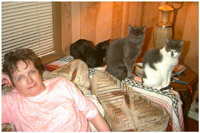
When I think of the 2,996 individuals who died at WTC, I think of Sandy Brace — the only one I knew — and try to multiply that out.
I can never do it; it’s too big.
I try anyway.
She was an acquaintance at Writing.com back when I was an angsty, teenaged writer. She wrote about her family, her cats, the loss of her mother, staring out her office window on one of the upper floors and dreaming of what she’d write next. The need to live before time runs out.
Her time ran out way too quickly for way too little reason.
RIP, Bandit’s Mama. I barely knew you, but I’ve never forgotten.
*
Sandy’s writing profile (last login on 9/7/01):
http://www.writing.com/main/portfolio/view/sandybrace
About her life, and the day before her last:
http://memorial.mmc.com/pgBio.php?ID=30
Her 9/11 memorial page:
http://www.legacy.com/toledoblade/sept11/Story.aspx?PersonID=119106&location=2
*
From Sandy’s poem “Transformation”:
As each of us grows ever older, we return to our childhood.
We return to the fragility and softness of those early years.
There, if we are lucky and search for it, we will find
The sweet wonder of our growing time and memories
That fill our throats with joy. We will feel again the laughter
And the peace of those distant years.
[...]I wearily endure the weight
Of my time and a silence in my heart. I feel the stillness,
But there is not sorrow. I sense quiet, but there is not loneliness.
Withdrawing now from my world, I fold my soul into myself
On this day that is mine, and I hug my aching bones.
[...]
From “Sandra Conaty Brace: 25 Cats, 55 Words”:
(Source: http://memorial.mmc.com/pgBio.php?ID=30)
Sandra Conaty Brace might have appreciated a short biographical sketch about her. After all, she herself had mastered the 55-word short story — a challenge to the most diligent amateur writer. Mrs. Brace had published much of her work on Web sites dedicated to the genre.
Mrs. Brace lived in Stapleton, Staten Island, and took the 7:40 a.m. ferry across the harbor each day to her job at Risk Insurance Solutions, where she was an administrative assistant. She shared her house with a husband, David, and 25 cats. Well, maybe not exactly 25. “It’s probably more,” Mr. Brace said, “But I lose count.”
Dinner for the cats always caused a minor food riot, but even a riot can have its own poetry. Mrs. Brace placed cat food on seven plates on the kitchen and dining room floors. The groups of cats arrayed around each plate formed a furry constellation of stars, with the plates at the centers and the cats as the coronas.
On Sept. 10, Mrs. Brace, 60, took the day off from work to do chores, fix the carpeting on the stairs that had been torn by a cat, and watch “Judge Judy” on television. Mr. Brace came home at 5 p.m.
He asked her: “Why don’t you take another vacation day tomorrow?” She replied, “No, I think I’ll go to work.”
“And that’s what happened,” Mr. Brace said. “That’s what happened.”
Before I was born, my parents lived in Bahrain for a two-year period. I grew up hearing stories and knowing the family they lived with in Manama as close, dear friends. They came to visit us stateside twice and taught me a lot as a kid, even though I was too young to realize it at the time.
We had a camel saddle in my living room, which we always used as furniture. I didn’t realize until junior high that nobody else in my school had one. My mother used to yell at me in Persian for misbehaving because she thought it would be less embarrassing for me in public, since the other shoppers probably wouldn’t understand what she was saying.
I’m utterly surprised and saddened at the news coming out of the kingdom right now because I always heard stories of it being a very progressive, fairly liberal Muslim country–and that was all the way back in the 1970s. My mother wore jeans and t-shirts. No one said a word to her. The younger members of the Bahraini family we knew did, too. It just wasn’t that big a deal; it was just a style choice as far as they were concerned.
There’s a big, long post I really want to write about Bahrain and the people who live there, but it’s going to take emotional energy, and I have none tonight. I couldn’t resist playing with some numbers, though, just to illustrate how closely-knit the citizens of this usually-peaceful kingdom must be.
Consider Tennessee. (Mostly because I’ve lived there a long time, and well, it’s my blog and that’s what I thought of first.) All of these numbers and images, by the way, are from Wikipedia.
.
Tennessee comprises 42,143 square miles.
.
.
Middle Tennessee, a region we locals are visually familiar with
(think weather maps and voting districts), measures 17,009 square miles.
.
.
Bahrain? The whole country? It’s 290 square miles.
(And yes, what you see here includes ALL of their main highways.)
.
That means Bahrain is 17 square miles SMALLER than
Cheatham County, TN, which looks like this:
.
That tiny, tiny sliver? Fits a whole freaking nation. Plus some.
Those people on the news aren’t just crying because of political upheaval. With every new death, they are losing family members, coworkers, and friends. Everyone in the country lives within 40 miles of everyone else.
I can’t imagine that.
But now I can picture it.
.
____________________
PS: And for my Nashville friends, your county gets 526 square miles. (The math on that makes Davidson County 236 square miles bigger than the whole of Bahrain.)
PPS: A Twitter conversation with Avery Oslo brought up the fact that Rhode Island, with 1,214 square miles is more than four times the size of Bahrain. There are four Bahrains in a Rhode Island?! I honestly didn’t think Rhode Island was bigger than anything but maybe a Wal-Mart.
It’s nothing too terribly fancy, but I love it. I can’t tell you why.
I found twelve of them at my mother’s house in a back room, drooled a little, and asked her where she’d found them. She said “Big Lots” and “a while ago”. A dated church bulletin crammed down in between the pages of the top one on the stack revealed what “a while ago” means. We’re talking 1993 here, folks. (At her church, that’s two or three pastors ago, even.)
They’re slim, they’re comfortably floppy, they’re probably theme books, and there are hieroglyphics everywhere on the cover, but no company name to be found. They are each saddle-stitched in a (removable? Not mine, so I didn’t try too hard) vinyl slipcover, and there are maybe, maybe, 20-30 pages in each of these babies, max.
I want some. They make me want to write quick short stories with a definite ending instead of the long rambling stuff I always start in Word docs on my computer and never finish. They also would work with my left-handedness, and not many journals actually do.
Help me out. Where can I buy these?
(And no, don’t think my mother will give me one for a second. No dice.)
It’s miserable outside,
but I can see them.
Indie publishing queen Zoe Winters, who keeps accidentally inspiring me to write these mondo-long blog posts when I’m innocently trying to procrastinate by reading her blog in the first place, spoke today about the myth of The New York Gatekeepers of Publishing.
From Zoe’s post:
There is a lot of hullabaloo about “good writing” vs. “bad writing”. And how do you know if you’re a “good writer” or not? The sad truth is that you can’t. I think one of the reasons the gatekeepers hold SUCH strong sway over unpublished authors is that they NEED to know if they’re good or not.And the reason they need to know, probably more than other types of artists, is that EVERYBODY thinks they can write. Whether they can or not. Everybody believes they have a book in them. It’s not like other forms of art like painting and sculpting and film where people seem to have some basic grasp of whether or not they suck.
So many writers don’t have enough self-confidence. And those that do often end up being the ones everybody mocks for self-publishing crap. So people are afraid if they have self-confidence it must mean they suck and are just deluded. So much ego is wrapped up in the act of writing.
When a NY publisher says: “Yes! We will buy this work!” They are validating you. They’re an authority figure. To many writers these gatekeepers mean more to them than end readers.
She’s right. Validation is a slippery thing.
I’ve found more trouble dispelling that crazymaking need for outward validation than any other aspect of the illusionary writing life. Every time I thought my big break was imminent, something always came along to knock me back down to my comfortable place on the bottom rung.
Usually, it was me.
And before you say, “Well, I don’t care what other people think, I’m writing for myself,” let me tell you: writing to publish “for yourself” as an end goal is impossible emotional level to hit and score against. Here’s why.
As a naive college kid, I remember thinking, “I’ll be a professional writer when I send out my first query letter to a major publishing house.”
Then I did just that, and it turned out to be not that big of a deal. My family was unimpressed that the Highlights editor hand-penned a couple of words on one corner of my green form letter. If I remember correctly, it was just my name, but I still did the happy dance. At first.
Of course, it wasn’t an acceptance or anything, so I decided that had been a dumb proclamation and aimed my sights higher. At, you know, publication, even.
A few years and several “real jobs” later, on a total fluke, I got a temporary gig as a journalist and it stuck. I was making $30 a week. The checks came in my name, like clockwork, for my words. In fact, I still remember the date and the weekday I first saw my name on the front page of a real, live newspaper.
But it wasn’t making-a-living money, and I wasn’t being creative; I was being a hack. I would know I was a real artist when I made some cash for something I felt like writing, not a city council recap. Something with authority, some prestige.
Then I thought, “Well, when I get my first acceptance for something creative, that’ll be how I know I’ve arrived.” I sent out a few subs and I got one, from a now-defunct online poetry zine. (Actually, I was in their last issue. Did I break it? Sorry, guys.)
But that was just a blog-style zine on some guy’s free webpage. It wasn’t a real, paper journal. (Don’t hit me, Zoe, this is past tense. We all know better now than to doubt digital.) I decided would know I was an actual writer when I made it onto a physically printed page which I could show my family. That would prove it.
Then I did, but it was poetry. It wasn’t a story. Try again. Then I got that, too. But it wasn’t for money, so I still had qualms about telling everyone else I was a “professional writer”.
I soon started working at a subsidy publishing house, editing books and learning how to do layout and define bindings to newbies and call Ingram and register copyrights. I made a couple of hundred a week for playing with books.
But they weren’t my books, so they didn’t count.
I became part owner of the publishing house when the former manager and majority owner had a huge shake-up, and I got to reorganize things to a degree. One of my partners and I decided to do an anthology, and we did. My name was right there on the cover. I wrote the introduction, selected the cover art, and wrote the press releases. I gave copies of the book to everyone for Christmas, and my extended family started thinking I was famous.
But I knew the truth; I had self-published it, and it didn’t have to pass anyone’s muster but my own. I knew it didn’t count…
I could go on and on, but I’ve kinda already done that.
Just trust me when I say there has been plenty more, and it’s all the same pattern.
Between those college kid days and where I am now were a ton of other random publishing jobs, lots of writerly dues-paying, and nods of validation from many people I used to be completely terrified of and intimidated by. Now I publish fiction and non-fiction pieces in all sorts of places, report weekly for a regional newspaper, edit other people’s books at a good wage, publish a literary magazine, own a book and graphic design company, and make enough between all these things to stay home and write exclusively.
My child goes to daycare so I can write, make conference calls, and manage publishing projects. I do this and nothing else for eight hours a day, every day of the week. My family is even buying that I’m a Real Writer, initials in caps. They buy me pen sets at Christmas.
I’m finally, provably established.
Yet every day as I’m running around doing these things, it’s still in the back of my mind that I haven’t sold anything to a NY publishing house and garnered a pretty little advance, written a full-length novel, or seen my name on a cover at Wal-Mart…
And yes, I know how silly that is. I get that now. All along the way, my goals only seemed ideal until I reached them. Then they lost their weight and became meaningless; because surely any goal that I could reach couldn’t have been that hard to begin with. Once a particular thing’s not impossible anymore, it becomes boringly attainable and I have to refocus elsewhere.
Silly or not, though, I think it’s human nature to keep pushing the golden ring further away out of your grasp. Since I’ve noticed my mental self-sabotage, I’ve watched others do it over and over and over again. My husband acts, and time and again I’ve seen him reach his goals only to instantly change them, brutally discounting everything he’s done so far. It’s that next step that will be the big break… even though last year, the “big break” was the thing that now he’s done.
Remember junior high? How if you were only in high school, people would have to listen to you and treat you like an adult? Remember high school? How if you only had a car, then you could go anywhere and conquer the world? It’s like that. Well, here you are. You have a car, you are an adult. Is it everything you thought it would be? Is life suddenly easier, perfect, tangle-free?
It only seems like an exclusive world when you’re outside looking in. It’s all about the imaginary prohibition. The people looking back at you through the glass are probably regretting their own yet-unreached pinnacles over the agent lunches you’re jealous of. The people sitting in publishing offices sipping lattes are likely daydreaming about other offices, other projects, other lives.
As one of my favorite Jackson Browne lyrics puts it:
No matter where I am
I can’t help thinking
I’m just a day away
From where I want to be
One of the things I’ve never thought to tell newer writers (which I suppose I should) is to set small goals—in writing—and keep the list somewhere so you can check yourself against it every few months. Maybe add more goals later on, sure; but make a rewarding pattern of Xs as you go.
Those checkmarks are worth everything, even when your ego outgrows that goal and looks for a new one.
And like Zoe said, so much of being in this business oftentimes comes back to ego. For better or worse, being a writer is part of being a writer, go figure, and it’s all part of the territory. It’s the weirdest kind of journey, and I don’t know of a single established writer who would stand on the mountaintop and proclaim that he is finished, everything meaningful in him has been written, and there are no new mountains to climb.
That’s a great thing. Ambition is what makes us better, makes us wiser, and gives us something to hope for. Yeah, it can be a curse, but it’s definitely a blessing, too.
Don’t ever stop reaching for new places, new heights.
Just remember not to miss the milestones along the way.
They count. They really do.